
Any mention of the name of Fredric Wertham at Comic-Con immediately elicits howls of derision and snarky comments. And not without reason. Wertham was, after all, a central figure in the assault on comic books in the 1950s that led to the elimination of most horror, crime, and suspense titles and precipitated the downfall of fans’ beloved EC Comics company.
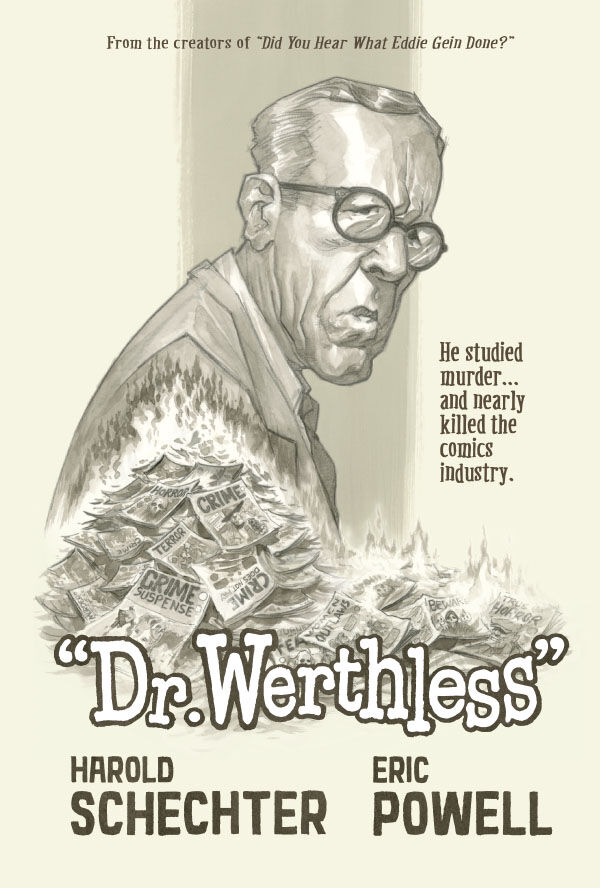
The title of the recent graphic biography of the doctor from Dark Horse Comics, Dr. Werthless, would seem to place it within the same cynically satirical camp. This is not the case, however. Written by Harold Schechter and Eric Powell, and illustrated by Powell, the book is, rather, a well-researched and nuanced account of the life of a complex individual. Powell’s illustrations, done with pencil and ink wash in period-appropriate black and white, capture the mood of the era and enhance the drama of the story.
The book echoes many of the widespread criticisms of Wertham. He was arrogant and intolerant of those who would criticize or contradict him. His difficulties working with colleagues hindered his advancement early in his career. In contrast, Wertham was, by all accounts, kind and understanding with his patients.
When Wertham entered the profession, psychiatry was still in its infancy as a scientific field of study. It was heavily influenced by the psychoanalytic approach of Sigmund Freud with a focus on neuroses rooted in early sexual development. Wertham believed personality is shaped by a wider range of factors, including both biological components and environmental influences.
His interest in the environment’s effect on mental health led to his most significant work. He was sympathetic to the plight of African Americans, seeing systemic racism as a factor affecting the mental health of Black Americans. With African-American novelist Richard Wright, Wertham established the LaFargue Clinic in Harlem to serve the Back community.
His characteristic obstinance proved to be a valuable asset when seeking to open the facility. After multiple attempts to raise funding failed, Wertham decided to charge ahead nonetheless and open the clinic with donated space in the basement of a church and a volunteer staff. He donated his time to help Harlem residents work through their problems. Charging no more than twenty-five cents, he was known as “Dr. Quarter.”
Based on his growing reputation in understanding the mental health concerns of African-Americans, he served as an expert witness in a 1952 school segregation lawsuit in Delaware. Wertham’s testimony regarding the psychological damage on both black and white children of governmentally sanctioned segregation helped to win the case and lay the foundation for the landmark 1954 anti-segregation Supreme Court decision Brown v. Board of Education.
His concern about environmental effects on mental health also drove his focus on popular media and the influence of movies and, most notably, comic books. His crusade against what he viewed as the corrosive effect of comics on the youth of America consumed much of his later life.
To be fair to the doctor, the crime and horror comics of the early 1950s were lurid and gory compared to the other popular media of the day such as movies and television. Yet Wertham’s assault on the medium continued even after the content of comics had been subsequently sanitized (due, in large part, to his efforts).
The book reveals many of the contradictions in Wertham’s anti-comics stance. A lifelong opponent to censorship, Wertham argued for legislation to constrain comics’ content. His reactionary position on comics stood in sharp contrast with his progressive views on other topics. He testified in the defense of a publisher of a nudist magazine accused of mailing obscene material. In 1953 Wertham testified about the dangers of solitary confinement on convicted atomic spy Ethel Rosenberg.
His hostility to the explicit nature of crime and horror comics is particularly ironic given two of his books published in the 1940s that detailed the crimes of patients he had studied: Dark Legend: A Study in Murder and The Show of Violence. Clothed in the garb of serious psychological studies, the books were filled with gruesome details as explicit as the comics and pulp novels Wertham railed against. In 1952, Dark Legend was adapted to a Broadway play, but received largely negative reviews. Wertham explored options to bring the books to the silver screen as feature films with no success.
Ultimately, Wertham failed to achieve the fame as psychologist he so desperately sought. His advancement of progressive ideals was largely obscured by his attacks on comic books. When Wertham died in 1981, his obituaries focused almost exclusively on his crusade against comics.
The Dark Horse book’s title, “Dr. Werthless,” comes from a 1957 Mad Magazine parody of Wertham illustrated by artist Wally Wood. Schechter and Powell’s book, in contrast, is a serious examination of the life of a complicated man.
 On Technology and Media
This book isn’t serious at all, but rather mindlessly and fallaciously attacks Wertham with the standard biased chorus, eliciting delighted howls from a legion of stubbornly ignorant and illogical fanbois, who, like the Werth-less author, have never even read Seduction.
And the publishers nearly destroyed THEMSELVES.
Wertham merely cataloged a small fraction of the wildly grotesque content they over-produced and swamped their own medium with, nearly destroying it all on their own, part of a familiar cycle of boom/bust which first occurred after WWII with most super hero titles collapsing.
Wertham’s core claims about the medium remained accurate post-Code in terms of the vigilanteism and violence it celebrates to this day, so one wonders why he would back away from his reasonable belief that modeling violence and revenge begets violence and revenge.
Werth-less, as its title attests, is worthless, biased nonsense.
Try reading Seduction instead, and make up your own mind.
LikeLike
Thanks for the comment. Although I have to wonder: Did you read Dr. Werthless? Rather than a mindless attack, it actually treats Wertham quite fairly, emphasizing his many of contributions to the social issues of the time, and portraying him as a complex, multifaceted individual.
The book’s title is, I think, unfortunate, in that it implies a cynical and negative view of the man which is not borne out by the book’s content.
LikeLiked by 1 person
Unlike most of those who delight in attacking both Wertham and his work while knowing little to nothing about it, I read every ridiculous page of Werthless, including the allegedly fair treatment of Wertham, bundled in to present the false impression that the author’s bizarre assessment is in any way rational or objective.
I’m glad we agree that the title is (at the very least) unfortunate, but the author had no incentive to attempt REAL biography or rational assessment, as I’ve learned in my own interactions with Wertham-hating fandom.
The book is a swamp of gossip, false claims, bias, fallacy and irrelevance, and utterly fails to prove its core claims.
But how could it prove these claims?
Wertham spoke glaringly obvious truths about pre-Code (as well as Code and post-Code) comic books, truths overlooked by most at the time, though brave souls such as Charles Schultz were clued into the ghoulish behavior of the publishers.
What the author appears to have done in cobbling together his Werthless book is cherry pick from the many poison trees of biased attacks on Wertham, including the work of professional Wertham ankle-biter Carol Tilley, guilty of all that she (often falsely) accused Wertham of.
But the author didn’t take on SOTI merely because he doesn’t appear to have read it (most other critics also guilty in this regard), but because one simply can’t honestly fight that battle and win.
And speaking of projection, is it my imagination that the author’s apparent obsession with sexual violence repeatedly derails the work in its attempt to suggest that Wertham was likewise so obsessed?
But that’s how classic scapegoating works isn’t it?
Wertham was right then, and he’s right now in the vast majority of his assessments of the medium, but the toxic nature of fandom may never permit these truths to be rationally assessed and accepted.
Werthless is a giant step backward in this regard, though frankly, it’s not the garbage heap I expected, but merely a bin filled with random trash, including the scraps of praise you mention.
Anyone – including you and me – could be trashed in the way the Werthless author savages Wertham, and all to the delighted howls of fandom. The book is a brainless hit job, and Wertham deserves so much better.
One could even make the counter-argument that Wertham helped SAVE comic books, making the Silver Age possible in some small regard, but that kind of logical progression of the tattered arguments of Wertham-haters has no place in the decades-long lynching of the reputation of a man who did more good in one lifetime than most of us could do in ten.
LikeLike
I enjoyed reading this non-fiction graphic novel myself, for it introduced me to a fascinating and flawed historical figure who left the public with an equal measure of good deeds and exploitive fanaticism.
LikeLiked by 1 person
Thanks for the response. It’s a fascinating book that presents a nuanced view of a complicated life. As I mention in the review—and in a previous comment—I fear the title, while clever, gives the impression the book is less balanced than it actually is.
LikeLiked by 1 person